Labels

Showing posts with label ants. Show all posts

Monday, April 25, 2011

Ants


Phylum  - Arthropoda
Class     - Insecta
Order    - Hymenoptera
Family   - Formicdae

How to Identify?

  • Antenna geniculate.
  • 2nd abdominal segment often reduced forming an isolated node or a scale (petiole).
  • 3rd abdominal segment often reduced (post-petiole).


The General life cycle of an Ant colony
  • (a) Colony founding phase.
  • (b) Phase of colony growth.
  • (c) Reproductive phase of a colony.


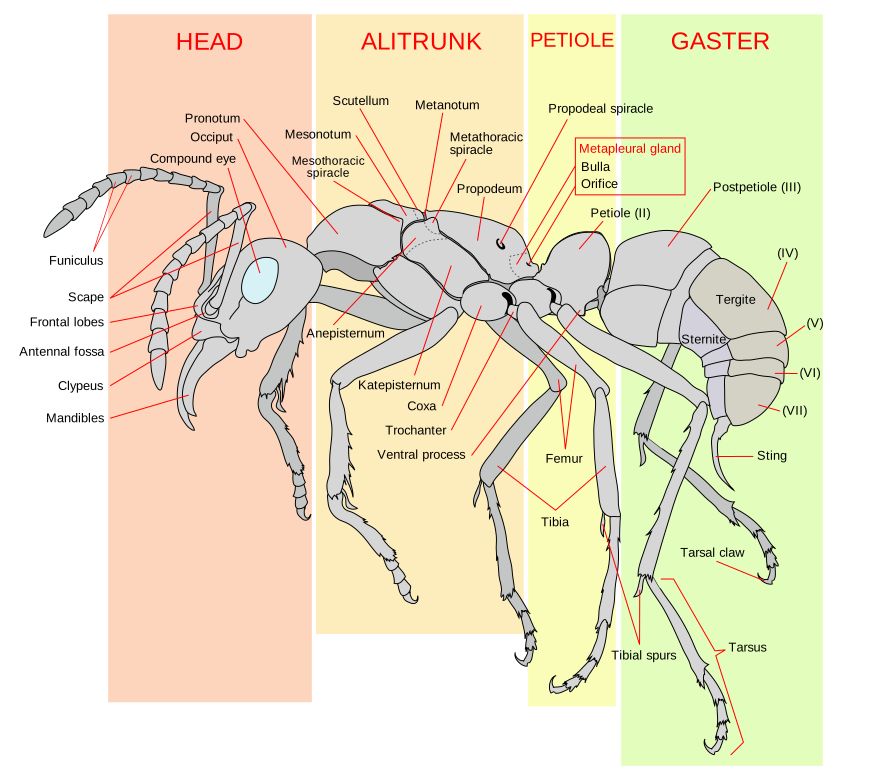
Taxonomically important Morphological Features of Worker Ants
  • Head.
  • Alitrunk (mesosoma).
  • Waist.
  • Gaster.

    Ants of Sri Lanka

    Nine subfamilies of worker ants have been recorded from Sri Lanka.
    • Aenictinae
    • Aneuretinae
    • Cerapachyinae
    • Dorylinae
    • Dolichoderinae
    • Formicinae
    • Myrmicinae
    • Ponerinae
    • Pseudomyrmecinae

      Field and Laboratory methods for the study of Ants

      Field sampling methods for Ants.

      It depends on the purpose of the study. Generally we can point out them briefly by following methods.
      1. Manual collection with a pair of fine forceps.
      2. Manual collection with a fine pointed (No.0) paint brush.
      3. Baited trapping.
      4. Pitfall trapping.
      5. Quadrat sampling.
      6. Special sampling methods for the leaf litter associated ants.
        i.  Litter lifters
        ii. Winkler sack
        iii. Berlese funnel
      7. Intensive sampling of ants.
      8. Sampling methods for arboreal ants.
        i.   Sweeping vegetation with insect nets.
        ii.  Beating vegetation with stick or shaking branches of trees vigorously to dislodge ants onto sheets or trays.
        iii. Setting up of sticky traps to capture ants.
        iv. Manual collection of ants on vegetation.

      *images from wikipedia

      Friday, February 18, 2011

      News of Giant Poisonous ANT...


      Giant poisonous ants trouble residents of Sri Lanka's Matara town

       
      Sat, May 29, 2010, 08:05 pm SL Time, ColomboPage News Desk, Sri Lanka.


      May 29, Colombo: Several areas around Matara and Weligama in the Southern Province have been affected by giant poisonous ants.
      These ants normally live on trees but occasionally invade houses and make dark corners their habitat. Some people are seriously allergic to their bites. They have complained of paralysis in parts of the body and red patches in the bitten places. Prof. Sriyani Dias of Kelaniya University, Zoological Department says a study will be conducted on these ants.
      Medical officers prescribe pain killers and tetanus vaccine to patients with ant bites, said the Medical Director of Matara General Hospital, Samindi Samarakoon.
      Agricultural officers are also studying the ants. Local residents note that ant bites of this nature were reported only after the recent floods. 

      more detail :-
      http://www.colombopage.com/archive_10A/May29_1275143723KA.php